
US to Require up to $15000 Bond for Visa Applicants from 12 New Countries


 May 10, 2026 5:03 am
US to require up to $15000 bond for visa applicants from 12 new countries the State Department announced a major expansion of its controversial visa bond pilot program on March 18, 2026, adding Cambodia, Ethiopia, Georgia, and nine other nations to a growing list of countries whose citizens must post hefty refundable deposits to enter the United States.
Effective April 2, 2026, passport holders from these 12 additional countries will join 38 others already subject to the bond requirement, bringing the total to 50 nations—approximately one-quarter of all countries recognized by the State Department.
12 New Countries Added to the Visa Bond List
The State Department’s March 18, 2026 announcement identified the following nations as the latest additions to the visa bond program
| Country | Region | Effective Date |
|---|---|---|
| Cambodia | Southeast Asia | April 2, 2026 |
| Ethiopia | East Africa | April 2, 2026 |
| Georgia | Caucasus | April 2, 2026 |
| Grenada | Caribbean | April 2, 2026 |
| Lesotho | Southern Africa | April 2, 2026 |
| Mauritius | East Africa | April 2, 2026 |
| Mongolia | East Asia | April 2, 2026 |
| Mozambique | East Africa | April 2, 2026 |
| Nicaragua | Central America | April 2, 2026 |
| Papua New Guinea | Oceania | April 2, 2026 |
| Seychelles | East Africa | April 2, 2026 |
| Tunisia | North Africa | April 2, 2026 |
US to require up to $15000 bond for visa applicants from 12 new countries—this expansion disproportionately affects African and developing nations, with most of the new additions located on the African continent.
How the Visa Bond Program Works?
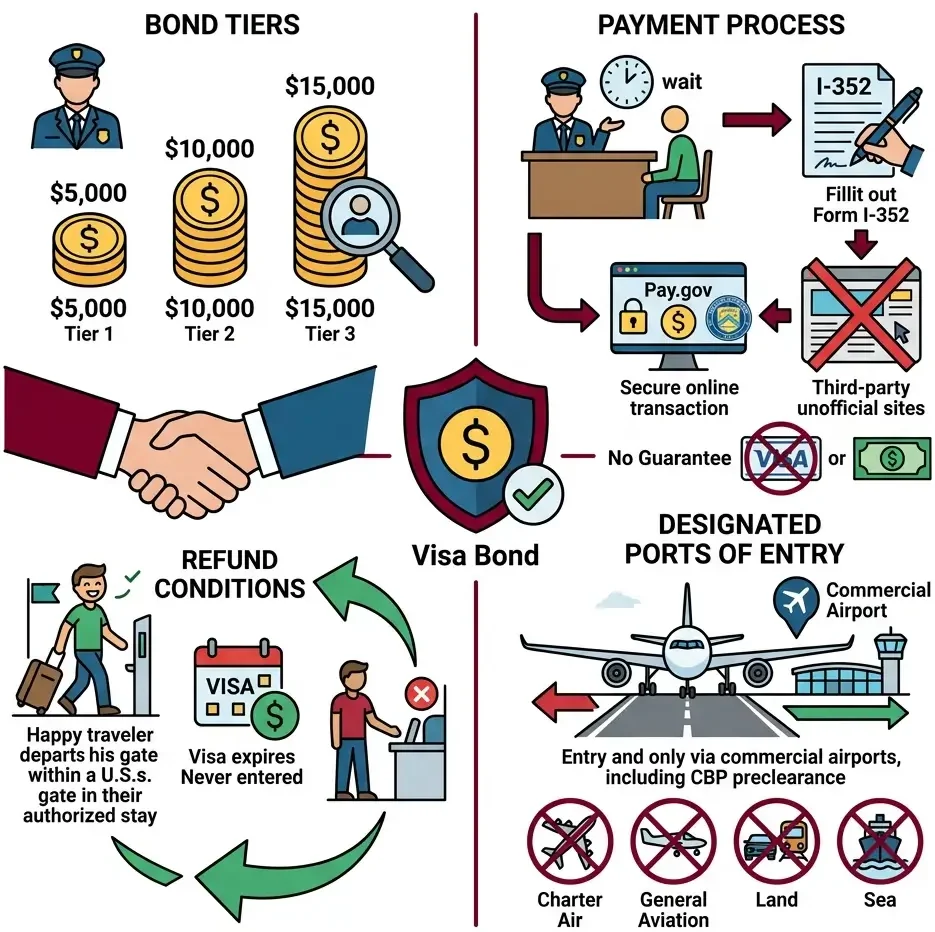
Bond Tiers and Payment Process
The visa bond program applies specifically to B-1 (business) and B-2 (tourist) visas. Under the pilot program, applicants from designated countries may be required to post one of three bond amounts:
The exact amount is determined by consular officers during the visa interview based on individual circumstances and risk assessment.
Payment Requirements
Applicants must follow a strict payment protocol:
Important: Posting a bond does not guarantee visa issuance. The bond is separate from standard visa application fees.
Refund Conditions
The bond is automatically canceled and refunded when:
Designated Ports of Entry
As a condition of the bond, travelers must enter and exit through commercial airports only, including CBP preclearance locations. Charter air, general aviation, land, and sea ports are prohibited.
Trump Administration’s Defense
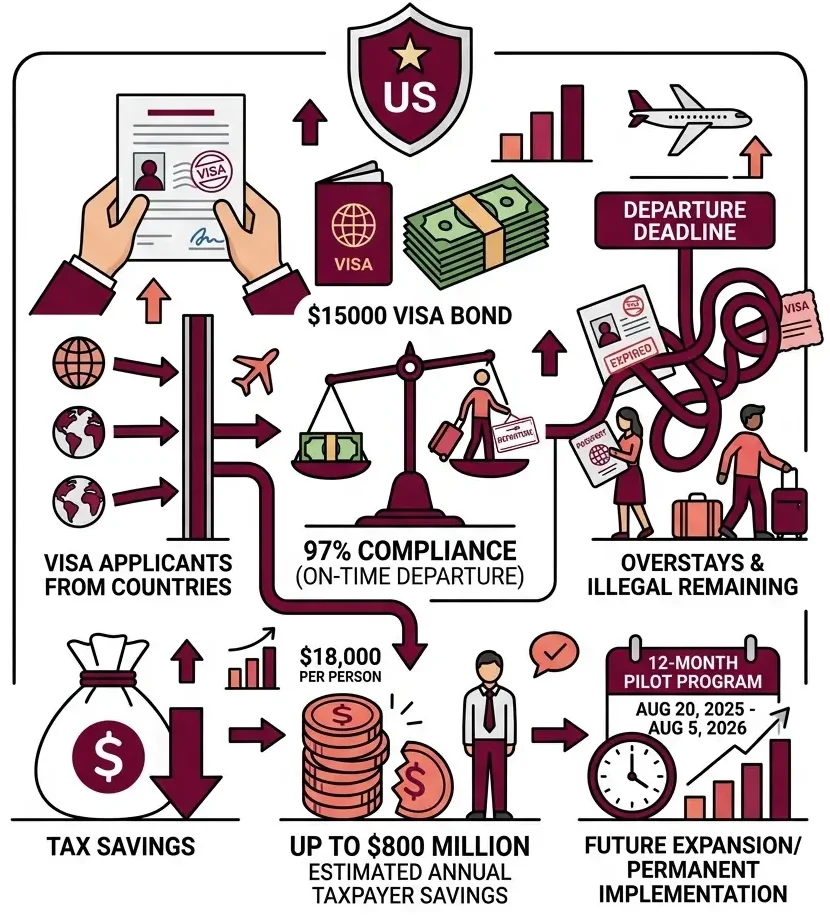
The State Department vigorously defends the US to require up to $15000 bond for visa applicants from 12 new countries policy, citing impressive compliance statistics:
“The visa bond program has already proven effective at drastically reducing the number of visa recipients who overstay their visas and illegally remain in the United States.” — U.S. Department of State
Key Statistics
| Metric | Figure |
|---|---|
| Visas issued under bond program | ~1,000 |
| Compliance rate (on-time departure) | 97% |
| Average cost to remove overstays | $18,000 per person |
| Estimated annual taxpayer savings | Up to $800 million |
The administration notes that during President Biden’s final year, more than 44,000 visitors from the now-50 bond countries overstayed their visas.
The program runs as a 12-month pilot from August 20, 2025, through August 5, 2026, though officials hint at possible expansion or permanent implementation.
Criticism and Concerns
Discrimination Allegations
Critics argue the US to require up to $15000 bond for visa applicants from 12 new countries policy discriminates against low-income travelers and creates a “pay-to-play” immigration system:
Business Community Concerns
Corporate stakeholders face new challenges:
World Cup Implications
The expansion raises questions about the 2026 FIFA World Cup, co-hosted by the U.S., Canada, and Mexico. With fans from bond-required countries potentially facing substantial financial hurdles, tourism officials express uncertainty about economic impacts.
Complete List of 50 Affected Countries
| Effective Date | Countries |
|---|---|
| April 2, 2026 | Cambodia, Ethiopia, Georgia, Grenada, Lesotho, Mauritius, Mongolia, Mozambique, Nicaragua, Papua New Guinea, Seychelles, Tunisia |
| January 21, 2026 | Algeria, Angola, Antigua and Barbuda, Bangladesh, Benin, Burundi, Cabo Verde, Cote D’Ivoire, Cuba, Djibouti, Dominica, Fiji, Gabon, Kyrgyzstan, Nepal, Nigeria, Senegal, Tajikistan, Togo, Tonga, Tuvalu, Uganda, Vanuatu, Venezuela, Zimbabwe |
| January 1, 2026 | Bhutan, Botswana, Central African Republic, Guinea, Guinea-Bissau, Namibia, Turkmenistan |
| October 23, 2025 | Mauritania, Sao Tome and Principe, Tanzania |
| October 11, 2025 | The Gambia |
| August 20, 2025 | Malawi, Zambia |
Impact on Business Travel and Tourism
For Employers
Organizations should immediately:
For Travelers
Visitors from bond-required countries should:
FAQs About US Visa Bond Requirements
What is the US visa bond program?
The visa bond pilot program requires certain B-1/B-2 visa applicants from countries with high overstay rates to post refundable bonds of $5,000, $10,000, or $15,000 as a condition of visa issuance.
Does paying the bond guarantee a visa?
No. The bond is paid only after a consular officer indicates approval is likely. If the visa is ultimately denied, the bond is refunded.
When does the 12-country expansion take effect?
The new requirements for Cambodia, Ethiopia, Georgia, Grenada, Lesotho, Mauritius, Mongolia, Mozambique, Nicaragua, Papua New Guinea, Seychelles, and Tunisia begin April 2, 2026.
How do I get my bond money back?
The bond is automatically refunded when you depart the U.S. on time, never use the visa, or are denied entry. No separate application is required.
Can I enter through any airport?
No. You must use commercial airports with CBP processing. Charter flights, private aviation, land borders, and seaports are prohibited for bond holders.
Is this program permanent?
Currently, it is a 12-month pilot program running through August 5, 2026. The State Department may extend, expand, or make it permanent

Conclusion
The expanded US visa bond program represents a significant shift toward financial barriers in immigration policy. While the administration cites strong compliance rates, critics warn of discriminatory impacts on developing nations. Travelers and businesses must adapt quickly to these evolving requirements.
Najeena Najeeb
I am Najeena Najeeb, a travel information writer with experience in Qatar visa processes and immigration guides. I help users check visa status, understand requirements, and avoid common mistakes.