GCC Resident Visa: Qatar Visa Options, Hayya Portal & 2026 Updates


 May 18, 2026 4:05 pm

Living across the Gulf as an expat means cross-border travel is part of life whether it’s a work trip to Doha, a weekend in Dubai, or a family visit through Muscat.
The GCC resident visa system exists precisely for this, giving residents of all six Gulf countries structured, simplified pathways to move across the region without the complexity of standard tourist visa applications.
This guide covers every visa option available to GCC residents traveling to Qatar in 2026, including recent updates to the Hayya platform, eligibility rules, fees, and the much-anticipated Unified GCC Tourist Visa.
Key Aspects of GCC Resident Visas
The GCC resident visa landscape works differently depending on which country you are entering, but the underlying logic is consistent across the bloc. Here is how each country approaches it:
| Country | Visa Type | Key Detail |
|---|---|---|
| Qatar | Hayya Platform (eVisa) | Online application; visa-on-arrival also available at QAR 100 |
| Saudi Arabia | eVisa | Requires valid GCC residence permit and approved profession |
| UAE | Online Entry Permit | Valid 30 days, extendable once |
Across all three portals, the standard documents required are:
The residency permit must generally be valid for a minimum of 3–6 months, and your profession must appear on the approved list for the country you are entering. For Qatar specifically, the Hayya app or website is strongly recommended over the visa-on-arrival route both cost QAR 100, but the online route removes border uncertainty entirely.
The most significant development on the horizon is the Unified GCC Tourist Visa a Schengen-style single permit allowing movement across all six countries without separate applications. Projected costs sit between $90 and $130, with a 2026 pilot launch now being discussed across travel-industry circles.
Qatar Extends Hayya GCC Resident Visa to 60 Days
On 29 November, Qatar’s Ministry of Interior updated the Hayya platform ahead of the 2025 FIFA Arab Cup, making two major changes:
The change was felt most immediately by UAE residents, who make up the largest share of cross-border spectators after Saudis. Here is what it means in practice:
| Who Benefits | How |
|---|---|
| UAE-based employers | Secondment planning over 8 weeks instead of compressed 30-day rosters |
| Consultants | Can stack Doha assignments without repeated exit-re-entry runs |
| Event-sponsorship teams | Staff rotations staggered across the full window |
| Leisure travelers | No need to shuttle back to Dubai mid-project |
| Airlines (flydubai, Qatar Airways) | Projecting a 15% bump in load factors with added frequencies |
Applications remain fully digital. UAE residents must upload their Emirates ID and residency visa. Processing times average 48 hours, though early submission is strongly advised given the surge in demand ahead of the 10 December kick-off.
The update has also intensified pressure on the GCC to launch its long-promised single tourist visa, now pushed to a 2026 pilot with travel-industry federations pointing to Qatar’s agile policy changes as proof that flexible visa regimes unlock both tourism and professional mobility.
Qatar Visa Options for GCC Residents in 2026
Qatar offers three structured visa pathways for GCC residents, alongside the broader Unified GCC Tourist Visa still in its final rollout phase.
While the Schengen-style single permit for all six countries Saudi Arabia, UAE, Qatar, Kuwait, Bahrain, and Oman represents the future of Gulf travel, the primary entry methods for GCC residents in early 2026 remain:
| Visa Type | How to Apply | Duration |
|---|---|---|
| Visa on Arrival | At the airport | 30 days |
| Hayya Visa (A2) | Online via Hayya Portal | 30 days (extendable) |
| Companion of GCC Citizen (A4) | Via sponsoring GCC citizen | Variable |
You can track your visa status anytime through the official Qatar Visa Check page on the Hayya homepage.
What is The Unified GCC Tourist Visa?
The Unified GCC Tourist Visa is no longer just a proposal it is in its final rollout phase, with Qatar confirming full technical readiness in early 2026. In simple terms, it is a single entry permit that allows tourists to visit all six GCC countries:

For 2026, the system is still launching in phases. GCC residents will continue using the Qatar-specific Visa on Arrival and the Hayya A2 Visa as their primary entry methods until the unified permit is fully operational.
Types of Visas for GCC Residents
Qatar offers three visa types for GCC residents in 2026:
| Visa | Application Method | Cost | Duration |
|---|---|---|---|
| Visa on Arrival | At the airport | QAR 100 (~$27 USD) | 30 days |
| Hayya Visa (A2) | Online via Hayya Portal | QAR 100 (~$27 USD) | 30 days (extendable) |
| Companion of GCC Citizen (A4) | Via GCC citizen sponsor | QAR 100 | Variable |
Each visa type has its own eligibility rules and application process, covered in detail below.
Option 1: Qatar Visa on Arrival for GCC Residents
The Visa on Arrival is the most spontaneous option — no advance application needed, just show up with the right documents. That said, it only works if your profession appears on Qatar’s approved list.
Requirements

Cost and Duration
Approved Professions List
Qatar maintains a specific list of eligible occupations. If your GCC residence permit lists one of the following, you qualify:
Accountants, Advisors, Air traffic controllers, Archaeologists, Astronomers, Auditors, Bank managers, CEOs, Chemists, Consultants, Diplomats, Doctors, Engineers, Financial analysts, Geologists, Hotel managers, IT experts, Judges, Lawyers, Pilots, Professors, Scientists, Ship captains, TV directors, Veterinarians, Writers
Option 2: Hayya Visa for GCC Residents (Hayya A2 Visa)
The Hayya A2 Visa is the smarter choice for most GCC residents — applied for online before travel, confirmed by email, and carrying none of the border uncertainty that comes with showing up and hoping your profession clears the list.
Eligibility
Fees and Penalties
| Item | Cost |
|---|---|
| Visa fee | QAR 100 (~$27 USD) |
| Overstay fine | QAR 200 (~$55 USD) per extra day |
| Extension fee (per month) | QAR 200 (~$55 USD) |
The fee is non-refundable even if you cancel your trip. The visa is valid for 30 days, extendable for up to two additional months.
How to Apply For Hayya Visa for GCC Residents?
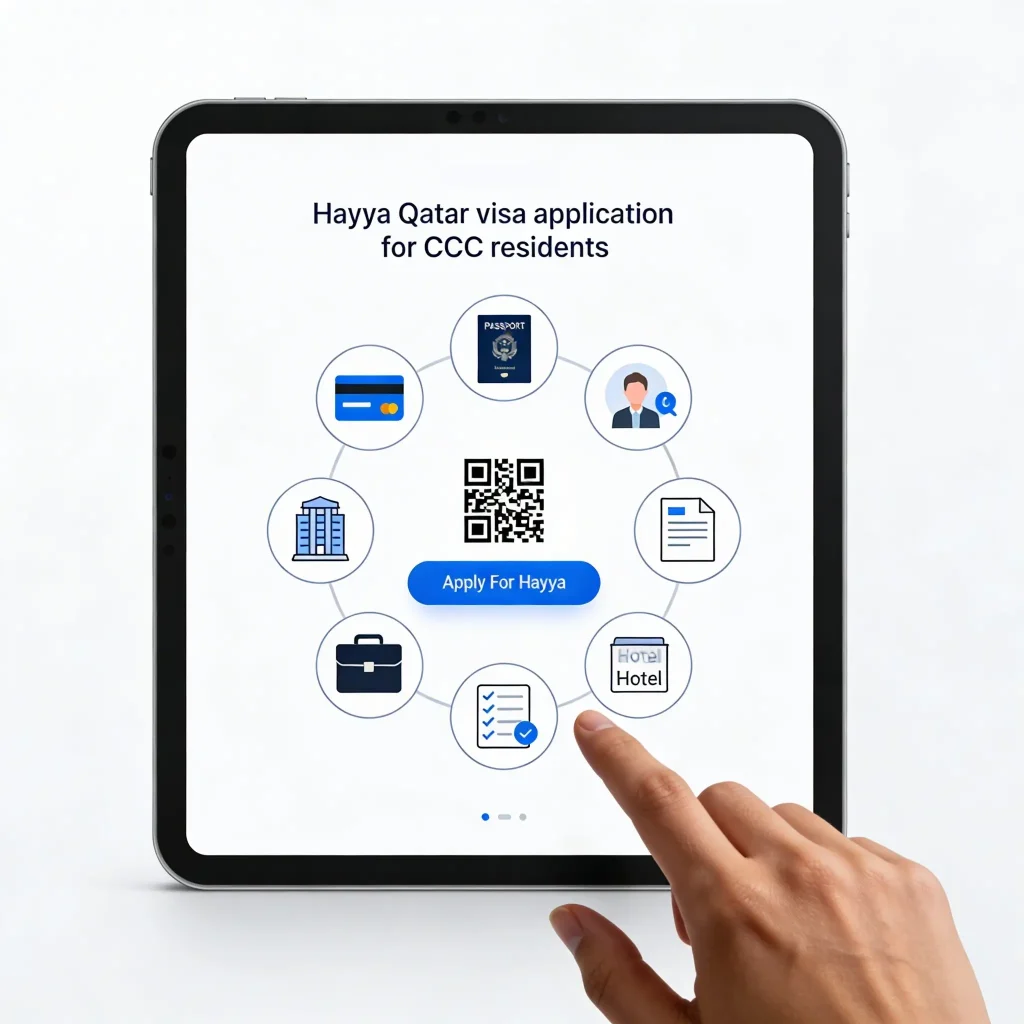
Once payment is confirmed, your Hayya Entry Permit is sent by email and remains valid for 90 days from the date of issue.
Option 3: Visa for Companions of GCC Citizens (A4)
If you are traveling alongside a GCC citizen who is sponsoring your visit, this is your visa category.
Requirements
For family members who are not GCC residents, the Tourist Entry (A1) visa is available to citizens of over 90 countries for standard tourism visits to Qatar.
Visa on Arrival or Hayya Visa for GCC Residents?
| Factor | Visa on Arrival | Hayya Visa (A2) |
|---|---|---|
| Application timing | At the airport | Before travel (online) |
| Profession restriction | Approved list only | Open to all professions |
| Risk of refusal | Yes, possible at border | No — confirmed before travel |
| Cost | QAR 100 | QAR 100 |
| Peace of mind | Lower | Higher |
If your job is on the approved list and you are comfortable with a small degree of border uncertainty, the Visa on Arrival works. If you want certainty before you fly or your profession is not on the list apply for the Hayya Visa online.
Qatar Visit Visa for GCC Residents
Qatar offers a 30-day single-entry visa on arrival to residents of all six GCC countries — Bahrain, Kuwait, Oman, Saudi Arabia, the United Arab Emirates, and Qatar. The facility is designed to be hassle-free, reflecting Qatar’s commitment to smooth regional travel.
The Qatar Ministry of Interior reconfirmed the GCC visa-on-arrival scheme for 2026, with one notable update: stricter verification of GCC residency professions at the border. If your permit lists a labor-category profession, expect more scrutiny than before.
Eligibility for Qatar Visit Visa
| Eligibility Criteria | Detail |
|---|---|
| Residency | Must be a current resident of a GCC country |
| Passport validity | Minimum 6 months from date of entry into Qatar |
| Residency permit validity | Minimum 3 months from date of entry |
| Approved profession | Must appear on Qatar’s approved professions list |
Qatar updated its approved professions list in 2026, adding medical, engineering, and IT categories while restricting certain labor professions a change that caught a number of residents off guard at the border.
Joint Visa Agreement: Qatar and Oman
Outside the standard GCC resident visa framework, Qatar and the Sultanate of Oman have a separate joint visa agreement worth knowing about. Under this arrangement:
This visa is available to citizens of 33 countries:
Andorra, Australia, Austria, Belgium, Brunei, Canada, Cyprus, Denmark, Finland, France, Germany, Greece, Hong Kong, Hungary, Iceland, Ireland, Italy, Japan, Liechtenstein, Luxembourg, Malaysia, Monaco, Montenegro, Netherlands, New Zealand, Norway, Poland, Portugal, San Marino, Singapore, South Korea, Spain, Sweden, Switzerland, United Kingdom, United States, Vatican City.
Process of Applying for a Qatar Visit Visa Through the Hayya Portal
The Hayya portal has genuinely simplified what used to be a frustrating process. GCC residents can also apply for a Qatar e-Visa through the same system.
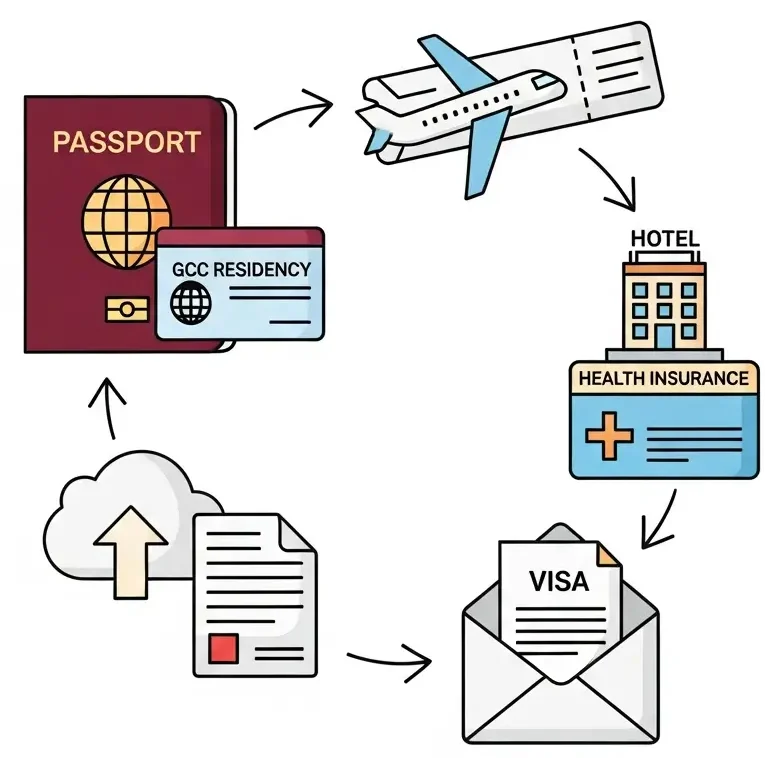
Documents Required
Submission and Approval
Once all documents are uploaded and the fee is paid online, the application is submitted for review. Approval typically takes a few days. Once approved, the visa is emailed to the applicant and must be printed and presented at the immigration counter upon arrival in Qatar.
Qatar Visit Visa Rules and Regulations
Entry and Stay
Overstay Penalties
| Violation | Penalty |
|---|---|
| Overstay fine | QAR 200 (~USD 55) per day |
| Repeated overstays | Possible travel ban to Qatar |
Health Insurance
Health insurance is mandatory for all visitors to Qatar. Guidelines are set by the Ministry of Public Health (MOPH). Check the MOPH official website for the current list of accredited insurance companies before travel.
Note: If you intend to work in Qatar, a visit visa does not cover employment. You will need a work visa, sponsored by a Qatari employer and processed through the Ministry of Labor.
Unified GCC Tourist Visa
The unified GCC tourist visa has moved well past the announcement stage. Qatar confirmed full technical readiness for the system in early 2025, and the goal is clear:
UAE residents can still apply for a standalone e-visa to Qatar in the interim. Qatar’s three existing visa options for GCC residents reflect the country’s active role in the unified visa initiative — and its broader ambition to serve as a regional hub for tourism, business, and cultural exchange.
Qatar Updates Hayya Features for GCC Residents Visa
Qatar Tourism, in collaboration with the Ministry of Interior and the Permanent Committee for Managing Visitor Entry, announced updates to the Hayya GCC Residents Visa (A2) on 29 November 2025, effective 30 November 2025.
Hayya’s Five Visa Categories
| Visa | Code |
|---|---|
| Tourist Visa | A1 |
| GCC Resident Visa | A2 |
| Visa with ETA | A3 |
| Companion of GCC Citizen Visa | A4 |
| Visa-Free for US Citizens | F1 |
Saeed Al Kuwari, Director of Hayya, described the updates as a reflection of Qatar Tourism’s broader vision to strengthen regional openness, facilitate visitor movement during major sports and cultural events, increase arrivals, and enhance tourism’s contribution to the national economy.
Beyond visa processing, the Hayya platform integrates:
It also supports airports and land border entry, encourages exploration of Qatar’s cultural landmarks and natural attractions, and provides tailored digital solutions for organisers, delegates, and attendees at major events.
Hayya Contact Center
| Contact Method | Detail |
|---|---|
| Languages supported | Arabic, English, Tagalog, Urdu, Hindi |
| Within Qatar | Call 2022 |
| From abroad | Call +974 4441 2022 |
| Available via the platform |
Qatar Hayya GCC Residents Visa Updated with Extended Stays and Multiple-Entry Access
The Hayya GCC Residents Visa (A2) has been updated from its original format in a meaningful way:
| Feature | Before Update | After Update |
|---|---|---|
| Entry type | Single-entry | Multiple-entry |
| Maximum stay | 1 month | 2 months |
The A2 is one of five Hayya visa categories and is specifically built for GCC residents. With this revision, it has become a significantly more practical instrument for both cross-border professionals and leisure travelers moving between Gulf countries.
FAQs About GCC Resident Visa
Do GCC citizens need a visa for Qatar?
No. GCC citizens can enter Qatar using their national ID cards — no visa required.
What if my job isn’t on the approved list for Visa on Arrival?
Apply for the Hayya Visa (A2) online through the Hayya Portal. The process is straightforward, the fee is the same at QAR 100, and you will have confirmation before you travel.
Can I stay in Qatar longer than my visa allows?
Yes, a Hayya Visa can be extended for up to two additional months. Each extra month costs QAR 200 (~$55 USD). Staying beyond your visa’s validity without extending it will result in daily fines.
What happens if I overstay my visa?
A fine of QAR 200 per extra day applies. Repeated overstays can result in travel bans affecting future trips to Qatar.
Can I apply for a Qatar visa while I’m already in the country?
No. The visa must be obtained before arriving in Qatar.
Do I need a return ticket if I’m entering Qatar by land?
Land border entries may be exempt from the return ticket requirement. Air travelers must carry a confirmed return flight.
Conclusion
Qatar’s visa options for GCC residents have never been more accessible. Whether you choose the Visa on Arrival, Hayya A2, or wait for the Unified GCC Tourist Visa, understanding the right pathway saves time, money, and unnecessary stress at the border.
Najeena Najeeb
I am Najeena Najeeb, a travel information writer with experience in Qatar visa processes and immigration guides. I help users check visa status, understand requirements, and avoid common mistakes.