Qatar Work Visa: Requirements, Process & Fees Guide


 May 10, 2026 6:47 am

Qatar sits among the Gulf’s most active labor markets, pulling in professionals, tradespeople, and specialists from every corner of the world. For many international workers, the first step to entering this market is securing a Qatar Work Visa. The economy runs on foreign talent from the construction sites shaping Doha’s skyline to the hospitals, hotels, and energy facilities keeping the country operational.
Getting there legally means understanding one system above everything else: employer sponsorship. Your employer is your anchor in Qatar. They apply for your visa, register your residency, and carry legal responsibility for your stay. Get that relationship right from the start, and the rest of the process follows a logical path.
Key Aspects of Qatar Work
Landing a job in Qatar is only half the battle what follows is where most people stumble. Skilled professionals lose weeks, sometimes months, simply because they misunderstood how the sponsorship chain works. The employer formally anchors the worker’s legal presence in the country, initiates the process by securing Ministry of Labor approval for the employment contract, and without that signed, formally approved contract, the work permit simply does not exist.
What surprises many first-timers is the structured sequence that follows arrival:
The initial entry visa is valid for 90 days and is extendable, but it is always meant to convert into a full residency card. Conversion costs approximately QAR 500, with the entry visa itself sitting around QAR 200 both fees typically employer-paid.
Qatar’s work visa structure covers a wide workforce spectrum:
| Visa Type | Duration | Best For |
|---|---|---|
| Standard Employment Visa | Long-term | Skilled & unskilled workers |
| Temporary Work Visa | 1–6 months | Project-based roles |
| Domestic Worker Visa | Contract-tied | Household staff |
Construction, healthcare, and hospitality continue to absorb the largest share of both skilled and unskilled workers. One thing that catches many off guard job switching during the initial period requires explicit approval, so read contract terms carefully before signing.
Types of Work Visas in Qatar
Not every worker coming into Qatar needs the same document, and choosing the wrong visa type early on can cost significant time and legal headaches. Here is how the landscape breaks down:
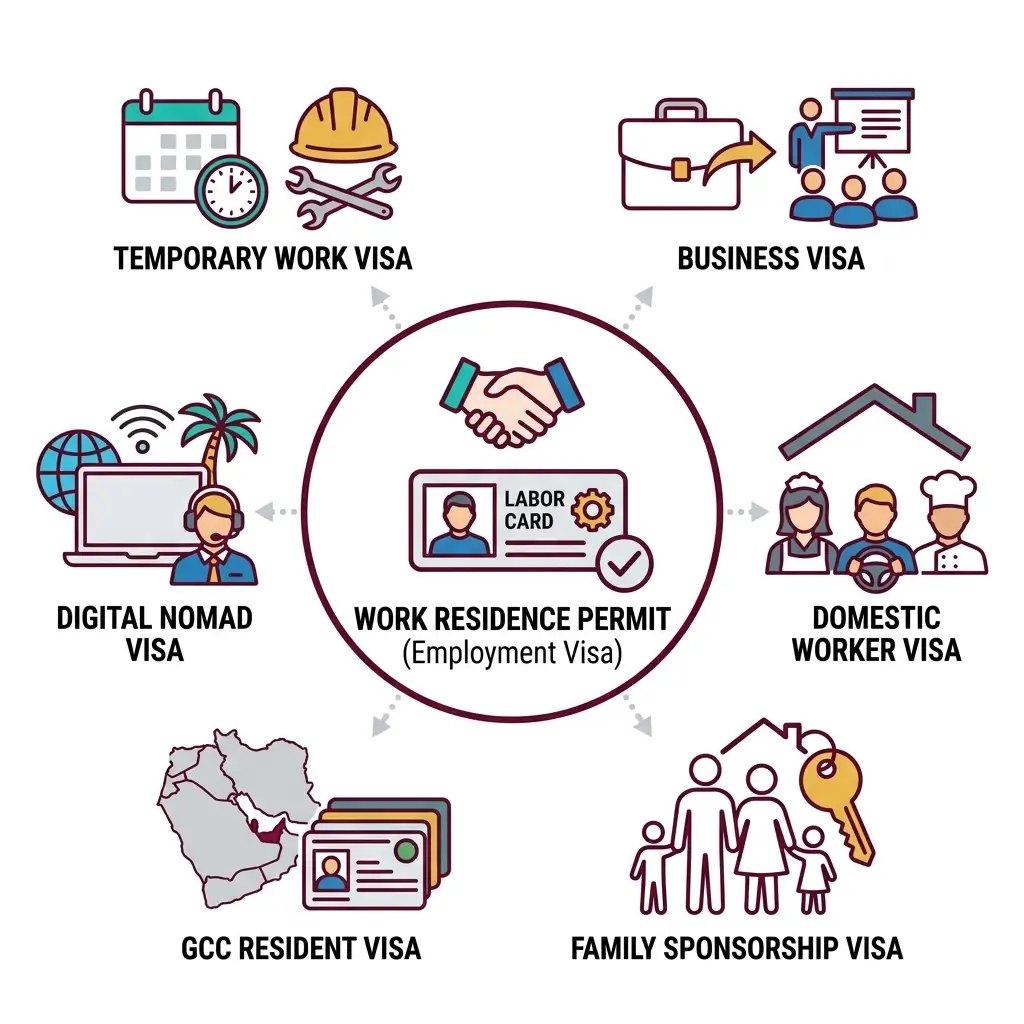
Work Residence Permit (Employment Visa): The backbone of Qatar’s foreign labor system. Valid for one to five years, entirely dependent on employer sponsorship and employment contract terms. Without a registered Qatari sponsor, this permit cannot be obtained independently. It is renewable, but renewal is also tied to the employer’s continued backing.
Temporary Work Visa: Designed for project-based assignments running one to six months — occasionally one to three months depending on project duration. Commonly used for consultants, contractors, and short fixed-term technical deployments. Generally non-renewable and must convert to a Work Residence Permit if the role continues beyond validity.
Business Visa: Valid for two weeks with a possible one-month extension. Covers meetings, conferences, and exploratory visits — it does not authorize paid employment. Anyone transitioning from a business visit into actual work must formally switch to a Work Residence Permit before starting.
Domestic Worker Visa: Operates under a completely separate regulatory track. Qatari families directly sponsor household staff — maids, drivers, nannies, and cooks — and assume full documentation, renewal, and compliance responsibilities under distinct Kafala system rules.
Family Sponsorship Visa: Allows expatriate employees to bring dependents — spouse and children — provided specific salary thresholds and accommodation requirements are met.
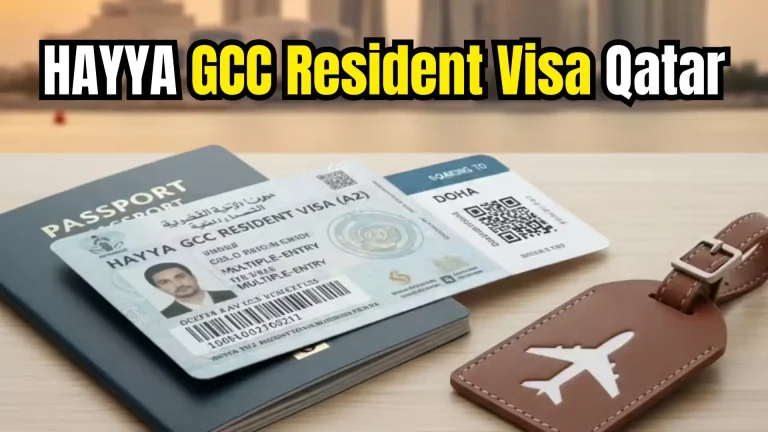
GCC Resident Visa: Simplifies entry for citizens of Bahrain, Kuwait, Oman, Saudi Arabia, and the United Arab Emirates through GCC mobility agreements, with eased documentation and different fee structures.
Digital Nomad Visa: Qatar’s newest category, designed for remote workers and online business operators tied to foreign employers actively being developed as part of the country’s infrastructure and technology growth strategy.
| Visa Type | Validity | Sponsorship | Key Limitation |
|---|---|---|---|
| Work Residence Permit | 1–3 years | Employer | Tied to specific employer |
| Temporary Work Visa | 1–3 months | Employer | Non-renewable, short-term only |
| Business Visa | 2 weeks–1 month | Approved companies | Cannot work; exploratory only |
| Domestic Worker Visa | Contract-tied | Family | Private residence employment only |
| GCC Resident Visa | 1 month | Simplified | GCC citizens only |
Work Permit and Residency Process
The work permit process moves in clear phases, and the employer carries the operational weight at almost every stage.
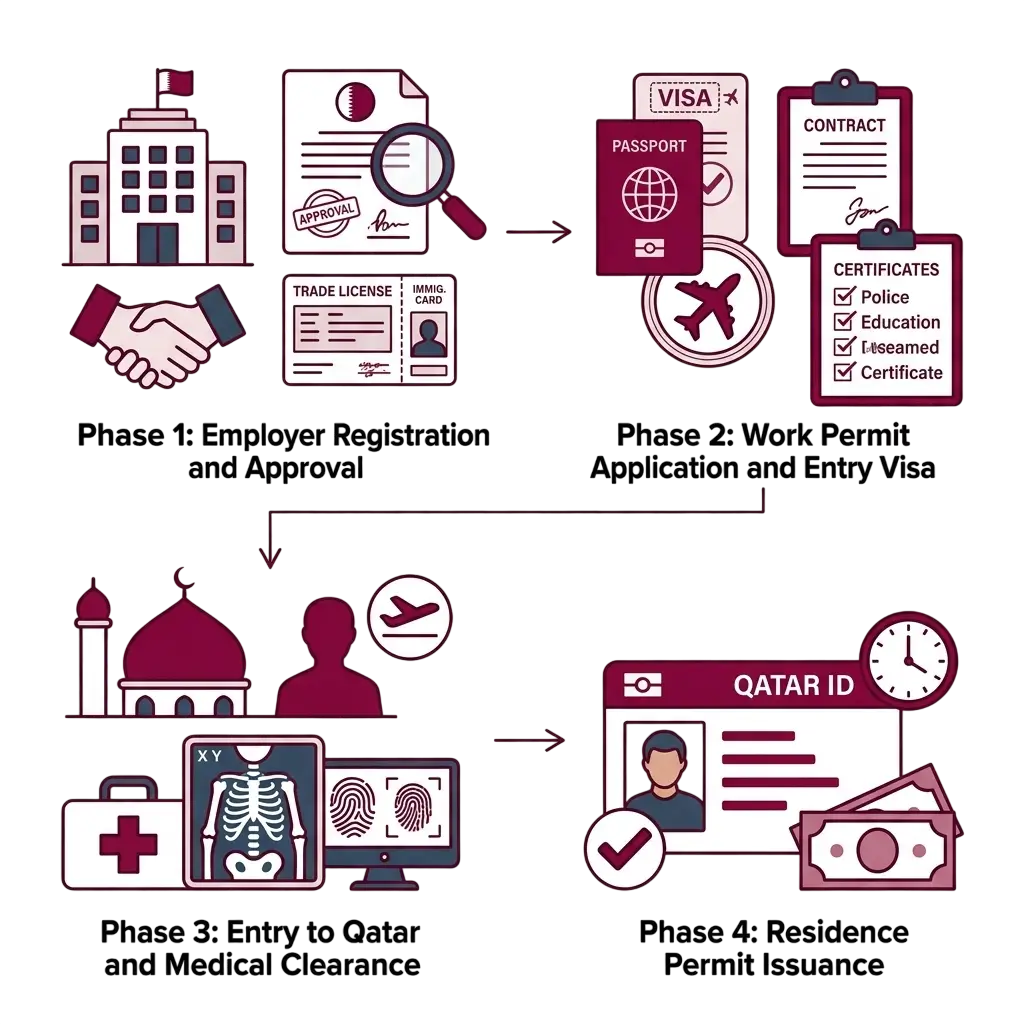
Phase 1: Employer Registration and Approval
Before any individual worker is named, the company must establish its authority to hire:
Phase 2: Work Permit Application and Entry Visa
Once quota approval is confirmed, individual visa applications move through the Metrash portal or immigration department with:
Phase 3: Entry to Qatar and Medical Clearance
Within seven days of the employee’s arrival:
Phase 4: Residence Permit Issuance
The entry visa converts into a full Work Residence Permit:
For companies managing payroll, tax obligations, and labor law compliance simultaneously, an Employer of Record (EOR) service can absorb much of this coordination load without the need for full entity formation.
Requirements for Qatar Work Visa
Before a single document gets submitted, the eligibility baseline needs to be firmly in place. Here is what Qatar’s Ministry of Labour and immigration authorities actually evaluate:
Eligibility Criteria
Age Limits
| Profession Type | Age Range |
|---|---|
| Most professions | 21–50 years |
| Certain skilled roles | Up to 60 years (with approval) |
| Some labor roles | Lower maximum (insurance-driven) |
Health and Medical Requirements
Document Requirements
Employer documents:
Employee documents:
All academic and legal documents must clear the Ministry of Foreign Affairs in the applicant’s home country, followed by final attestation at the Qatar Embassy before submission.
Documents Required for Qatar Work Visa
Document preparation is where the Qatar work visa process either flows cleanly or grinds to a halt. Here is the complete checklist:
Employee Documents
Employer Documents
Every document must align precisely with MOI specifications. Mismatches between any form and passport details — even a spelling variation — will delay or reject the application.
Cost of Qatar Work Visa
Budgeting for a Qatar work visa involves more moving parts than most employers initially expect.
Core Visa Fees
| Cost Component | Approximate Amount | Who Pays |
|---|---|---|
| Entry visa fee | QAR 200 / USD 55 | Employer |
| Residence permit conversion | QAR 500 / USD 137 | Employer |
| Work permit annual fee (2025) | QAR 100 / USD 27 | Employer |
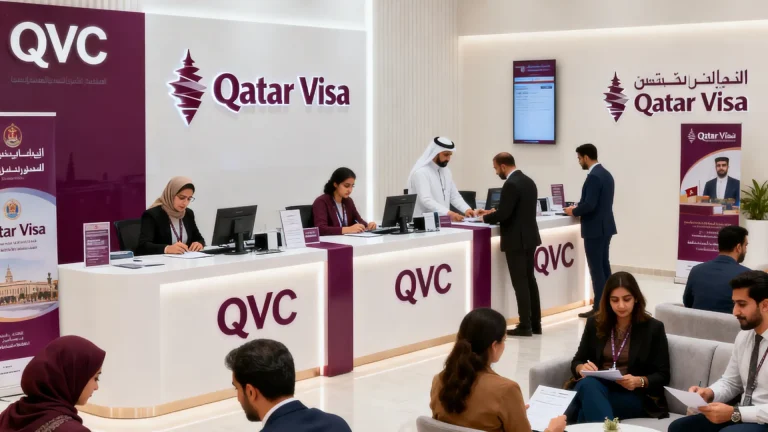
| Medical examination (QVC abroad) | QAR 300–500 | Employer/Employee |
| Medical examination (in Qatar) | QAR 100 | Employer/Employee |
| Biometric registration | QAR 150–200 | Employer |
| Document attestation | USD 5–15 per document | Employer/Employee |
| Police clearance certificate | USD 50–150 | Employee |
| Translation services | USD 27–110 | Employer |
| Total estimate (1-year permit) | USD 245–603 | Primarily employer |
Renewal Fees
| Sponsorship Type | Annual Renewal Fee |
|---|---|
| Company-sponsored employees | QAR 1,000 / USD 274 |
| Family-sponsored workers | QAR 500 / USD 137 |
| Personal sponsorship | QAR 300 |
| Three-year renewal | 20% discount applied |
Key 2025 Update Ministerial Decision No. 32/2025 A fixed annual work permit fee of QAR 100 (USD 27) now applies to all private-sector employees, covering new permits, renewals, and replacements. Exemptions apply for Qatari nationals, children of Qatari women, and GCC citizens.
Late Renewal Penalty: QAR 10 per day for overstaying without a valid permit.
For workers traveling from India, the entry visa fee converts to approximately INR 5,000, with the residence permit conversion running around INR 12,500.
Qatar Work Visa Application Process
The Qatar work visa application follows a fixed sequence skipping or rushing any stage causes delays that ripple through everything that follows.

Step 1: Quota Approval from the Ministry of Labour
Before any worker’s name enters the system, the employer must demonstrate that:
Without quota approval, no subsequent step is accessible.
Step 2: Drafting and Signing the Employment Contract
The contract must specify:
The signed contract is then registered with the Ministry of Labour.
Step 3: Submitting the Visa Application
Submitted through the Hukoomi e-government portal or at the immigration department with:
Step 4: Visa Approval and Issuance
Step 5: Medical Examination and Biometric Registration
Completed either before arrival at a Qatar Visa Center (QVC) or after arrival at an approved facility:
Step 6: Entry into Qatar and QID Processing
Within 7–30 days of arrival, the employer lodges the residence permit application:
Employer Responsibilities in Hiring Foreign Talent
Sponsoring a foreign worker in Qatar is a legal commitment that runs from the day the job offer is made to the day the worker exits the country.
Sponsorship
Through the Kafala system, the employer is responsible for:
- The worker’s legal status, welfare, and labor law compliance
- Submitting the work visa application and employment contract
- Coordinating biometric registration and medical examinations upon arrival
- Processing the residence permit within the seven-day window
Recent reforms have improved the balance of this system exit permits have been abolished, job mobility has been eased, and a non-discriminatory minimum wage protects all workers regardless of nationality.
Compliance
Renewals
Work visas and residence permits must be actively tracked and renewed before expiry:
| Sponsorship Type | Annual Renewal Fee |
|---|---|
| Company-sponsored | QAR 1,000 |
| Family-sponsored | QAR 500 |
| Personal sponsorship | QAR 300 |
Required renewal documents include the employee’s valid passport, updated employment contract, and current medical examination certificates.
Renewal of Qatar Work Visa
A work visa that lapses is not just an administrative problem it is a legal one that affects employment, housing, banking, and travel. Renewal strategy deserves as much attention as the initial application.
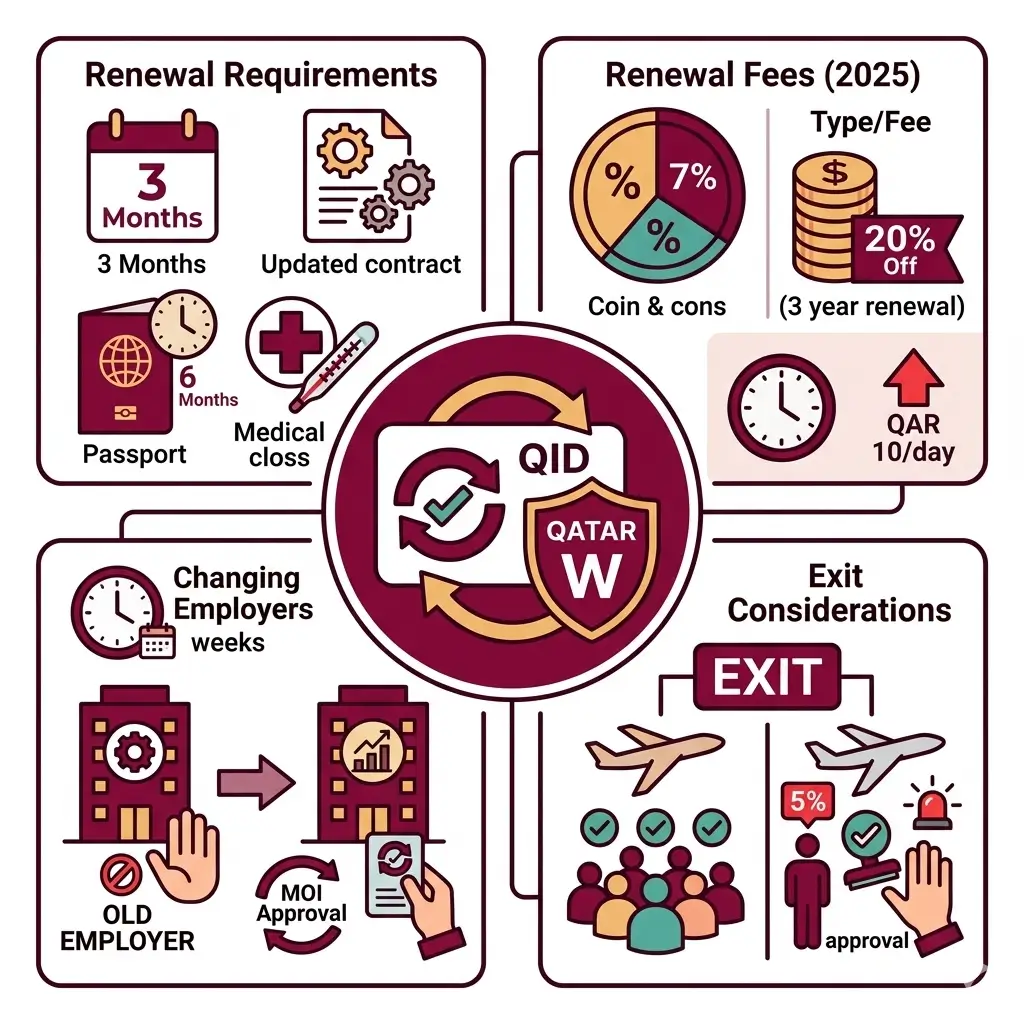
Initial Validity
| Worker Type | Permit Duration |
|---|---|
| Standard employment | 1 year initially |
| Project-based contracts | 3–6 months |
| Engineers, medical professionals, senior executives | Multi-year (aligned to contract) |
Renewal Requirements
Renewal Fees (2025)
| Type | Fee |
|---|---|
| Company-sponsored employees | USD 274 per year |
| Family-sponsored workers | USD 137 per year |
| Three-year renewal | 20% discount |
Late Renewal Penalty: QAR 10 per day calculated until renewal is completed or the worker leaves Qatar.
Changing Employers
Post-2020 reforms abolished the NOC requirement. Workers may now transfer sponsors after completing their contracts:
Exit Considerations
Exit visas were abolished in 2020. Employers may designate up to 5% of staff as critical, requiring approval before those individuals can leave Qatar. This designation should be used only with valid justification.
Challenges Global Employers Face with Qatar Work Visas
Every employer entering Qatar’s hiring market eventually encounters friction. These are the challenges that consistently surface:
1. Kafala Sponsorship System Complexity
Even with recent reforms, the employer still carries extensive administrative responsibility — documentation, renewal tracking, compliance monitoring, and employment change management all sit under the sponsor’s scope.
2. Multi-Agency Coordination
Applications route through several agencies with separate requirements and review timelines:
Missing documents at any single stage halts the entire process and can stretch hiring timelines from weeks into months.
3. Medical Exam Uncertainty
Mandatory medical exams can disqualify candidates regardless of professional qualifications. No appeal process exists. Employers carry that uncertainty until medical clearance is officially confirmed.
4. Documentation Attestation Complexity
Certificates and police clearances must be:
Incomplete attestation causes rejections that take weeks to resolve.
5. Limited Mobility During Processing
Workers typically cannot leave Qatar until the residence permit is issued, affecting personal planning and flexibility.
6. Annual Renewal Obligations
Late renewals result in QAR 10 per day fines, risk work stoppages, and in extreme cases, deportation. Payroll and benefits compliance errors trigger investigations and reputational damage.
Employer Readiness Checklist
| Readiness Item | Key Question |
|---|---|
| Company registration | Registered with Immigration Department and Ministry of Interior? |
| Ministry approval | Labour approval for foreign worker quota obtained? |
| Employer immigration card | Valid card authorizing sponsorship held? |
| Role eligibility | Position meets requirements for foreign worker sponsorship? |
| Employment contracts | Compliant with Qatar labor law on salary, benefits, termination? |
| Documentation systems | Can attest and submit required documents efficiently? |
| Medical facility partnerships | Approved medical facilities identified? |
| Biometric processing | Locations and procedures understood? |
| Payroll compliance | System configured for end-of-service gratuity? |
| Renewal tracking | Permit expiration dates actively monitored? |
| Legal support | Immigration specialists engaged? |
Where gaps exist, an EOR service can bridge compliance, sponsorship, and entity requirements without establishing a local branch.
Medical Examination and Health Requirements
The medical examination is a genuine gate in the Qatar work visa process not a formality. The Ministry of Public Health (MoPH) takes communicable disease control seriously, and that intent is reflected in how thoroughly the examination is structured.
Mandatory Health Tests
| Test Type | What It Screens |
|---|---|
| Blood tests | HIV/AIDS, hepatitis B, hepatitis C, syphilis, infectious diseases |
| Chest X-ray | Tuberculosis, lung conditions |
| General physical examination | Vital signs, BMI, chronic illnesses |
Where to Take the Medical Exam
| Situation | Where |
|---|---|
| Countries with QVC facilities (India, Bangladesh, Nepal, Sri Lanka, Philippines) | Qatar Visa Center (QVC) before departure |
| Countries without QVC facilities | MoPH-approved clinic in Qatar after arrival |
Biometric capture runs alongside medical processing fingerprints and facial photographs are registered at the CEID. Both medical clearance and biometric confirmation must be complete before QID issuance advances.
Nationality-Specific Requirements
Qatar’s general work visa framework applies universally, but several countries have layered additional bilateral agreements, recruitment regulations, and health protocols on top of the standard process.
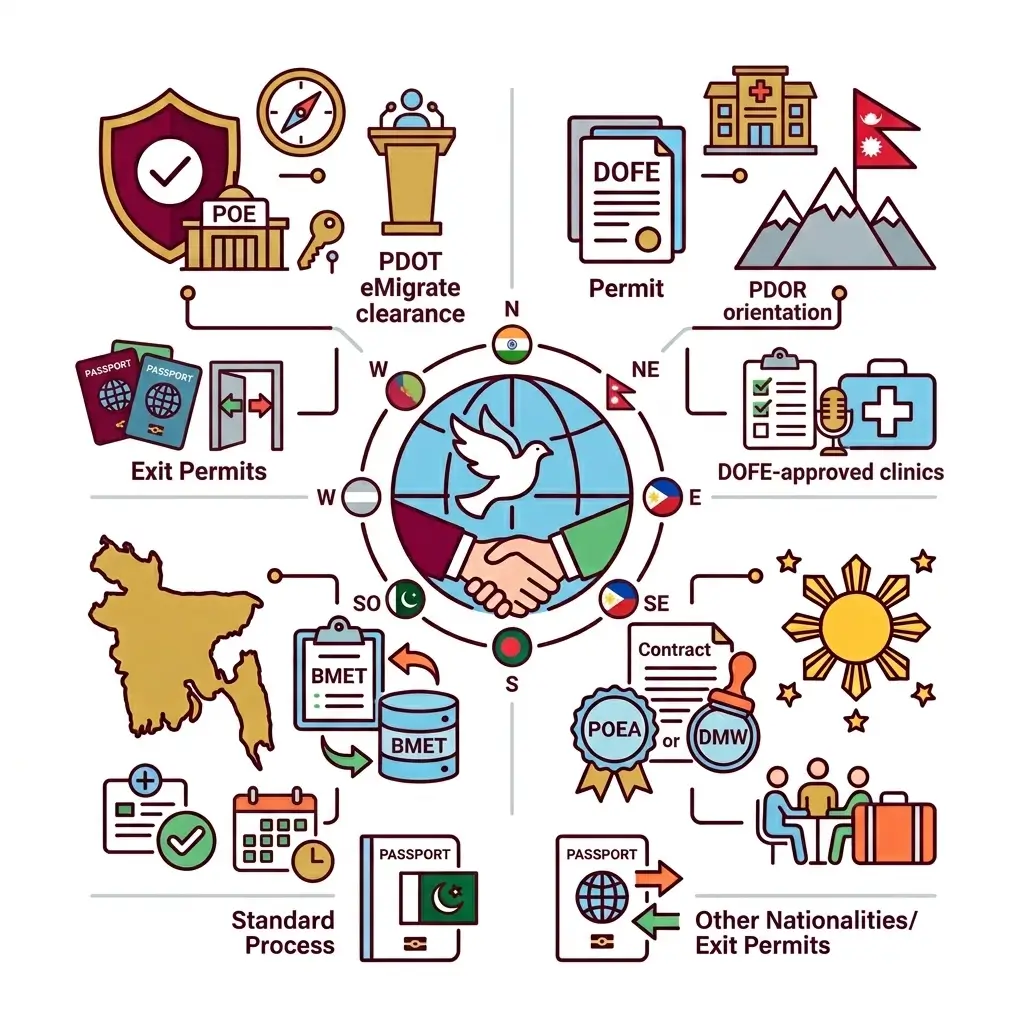
India
Nepal
Philippines
Bangladesh
Pakistan
Other Nationalities
Processing Time for Qatar Work Visa
| Stage | Typical Duration |
|---|---|
| Employer application to visa approval | 2–4 weeks |
| Pre-departure QVC processing (where applicable) | Adds 5–10 days before travel |
| Peak season delays (construction, events) | Extended beyond standard timelines |
| Applications with background checks | Up to 6–8 weeks |
| QID renewal (Hukoomi portal) | 3–5 working days |
| Medical re-examination for renewal (if required) | Adds 2–3 extra days |
How to Keep Processing On Track
Every missing or expired document at submission adds days sometimes weeks regardless of how straightforward the rest of the application appears.
Changing Jobs in Qatar
Job mobility in Qatar has shifted substantially since 2020, and the practical reality for workers today is meaningfully different from before the reforms.
Before vs. After 2020
| Aspect | Before 2020 | After 2020 (Law No. 18 of 2020) |
|---|---|---|
| NOC requirement | Mandatory | Abolished |
| Employer permission | Required to change jobs | Not required |
| Transfer process | Paper-based, employer-controlled | Online via Ministry of Labour platform |
Notice Period Requirements
Online Job Change Process
Resignation letters and maintaining good professional relations with the outgoing employer continue to have practical value even without the legal NOC requirement. These reforms have aligned Qatar’s labor system more closely with International Labour Organization (ILO) standards.
Working Hours and Minimum Wage in Qatar
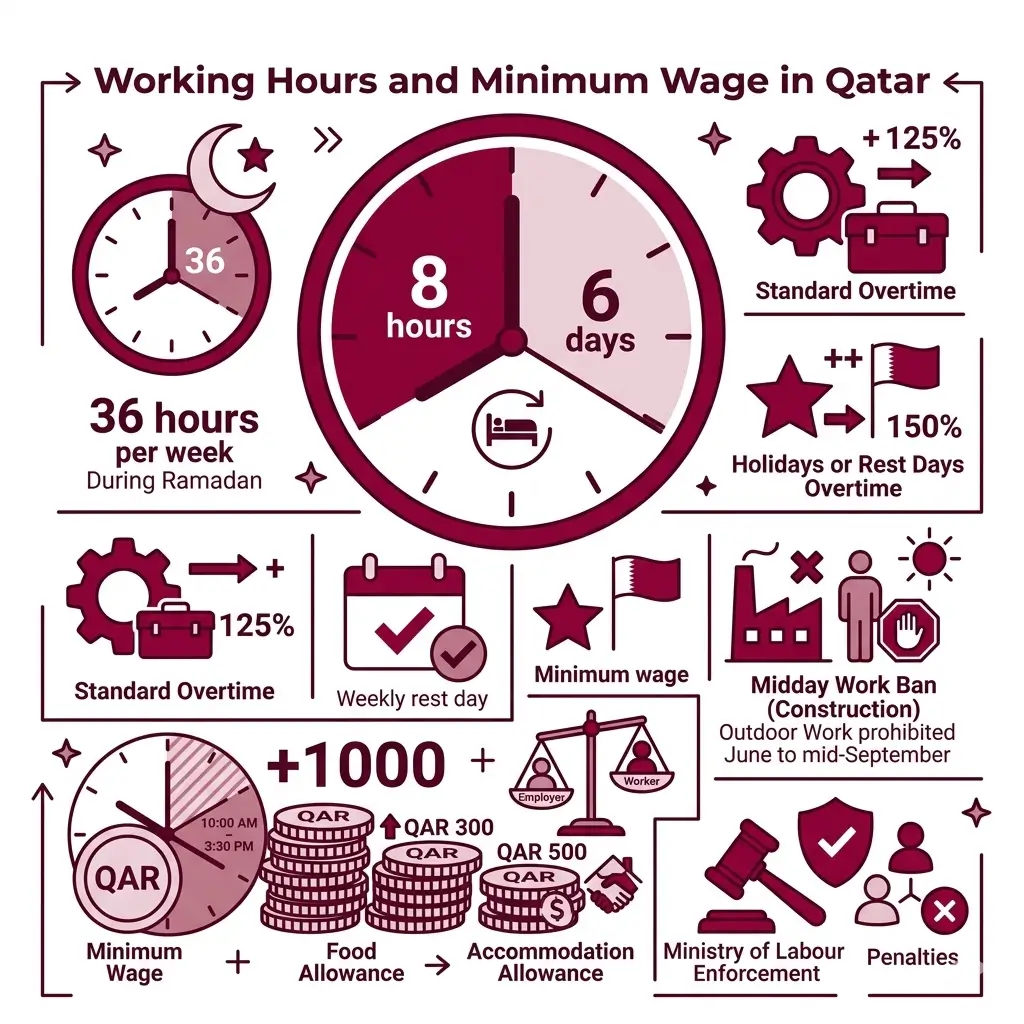
Employment conditions in Qatar are regulated by Labour Law No. 14 of 2004, with updates introduced to align with international labor standards.
Standard Working Hours
| Condition | Hours |
|---|---|
| Standard working week | 48 hours (8 hours/day, 6 days) |
| During Ramadan | 36 hours per week |
| Weekly rest day | Friday |
| Rest break entitlement | 1 hour per 5 consecutive hours worked |
Midday Work Ban (Construction) Outdoor work is prohibited between 10:00 AM and 3:30 PM from June to mid-September.
Overtime Pay
| Situation | Compensation Rate |
|---|---|
| Standard overtime | 125% of basic hourly wage |
| Holidays or rest days | 150% of basic hourly rate |
Minimum Wage (Introduced March 2021)
| Component | Monthly Amount |
|---|---|
| Base salary | QAR 1,000 |
| Food allowance (if meals not provided) | QAR 300 |
| Accommodation allowance (if housing not provided) | QAR 500 |
This minimum wage applies to every worker regardless of sector, nationality, or employment type — a genuinely non-discriminatory standard. Employers failing to meet these requirements face penalties under MOI and Ministry of Labour enforcement.
Benefits of Working in Qatar
Qatar’s appeal to expatriate workers is built on a combination of financial, lifestyle, and stability factors that consistently outperform most home markets.
Tax-Free Income No personal income tax, no social security deductions, no pension contributions taken from salary. The Ministry of Finance maintains this policy to attract global talent across oil and gas, engineering, and healthcare. What is in the employment contract is what the worker takes home.
Housing and Travel Benefits
Family Sponsorship
Workers meeting the income threshold can sponsor immediate family:
| Condition | Salary Threshold |
|---|---|
| Standard sponsorship | QAR 10,000 per month |
| With employer-provided housing | QAR 7,000 per month |
The Ministry of Interior’s Immigration Department manages the process, requiring proof of accommodation and health insurance for dependents.
Lifestyle and Infrastructure
Do GCC Citizens Need a Qatar Work Visa?
The short answer is no but GCC nationals still require some administrative steps that employers should not overlook.
Citizens of Bahrain, Kuwait, Oman, Saudi Arabia, and the United Arab Emirates benefit from the GCC Common Market framework:
Employer Obligations Still Apply
Family Sponsorship for GCC Nationals
| Document Required | Details |
|---|---|
| Valid working visa | Must be active |
| Birth certificates | For dependent children |
| Marriage certificates | For spouse |
| Proof of accommodation | Required for all dependents |
This streamlined arrangement reflects broader GCC economic integration goals, but active management of employment registration, QID issuance, and Qatari labor law compliance remains necessary.
Residency Permit in Qatar (QID)
The QID is the document that makes everything else work in Qatar. Without it, a worker cannot open a bank account, sign a housing contract, register a mobile phone, or access most government services.
How to Obtain the QID
The sponsoring company must initiate the QID application within the worker’s first seven days in Qatar:
Required Documents
| Document | Provided By |
|---|---|
| Original passport (6+ months validity) | Employee |
| Work visa copy issued by MOI | Employee |
| Passport-size photographs (MOI specifications) | Employee |
| Medical clearance certificate | Employee |
| Biometric receipt from MOI fingerprint department | Employee |
| Commercial registration (CR) | Employer |
| Company immigration card and establishment details | Employer |
Validity and Penalties
Rights and Responsibilities of Foreign Workers in Qatar
Qatar’s legal framework for foreign workers has evolved substantially, and the rights it now offers are meaningful provided workers understand them.
Worker Rights
| Right | Detail |
|---|---|
| Fair wages | National minimum wage — QAR 1,000 basic + allowances |
| Safe working conditions | Occupational health and safety standards enforced |
| Rest and leave | Weekly rest day, paid annual leave, sick leave, public holidays |
| End-of-service benefits | Gratuity calculated on length of service |
| Job mobility | Change employers without permission following official notice period |
| Access to justice | Free dispute resolution via Labour Dispute Settlement Committee |
Worker Responsibilities
Balancing rights with responsibilities shapes how foreign workers are received and how their careers develop in Qatar over time.
Visa Requirements for Digital Nomads in Qatar
Qatar’s visa system was built around sponsored employment, but the reality of global remote work is changing that.
Currently Available Options
| Visa Type | What It Allows | Limitation |
|---|---|---|
| Tourist visa | Stay up to 30 days (extendable) | No right to work for Qatari companies |
| Business visa | Meetings, conferences, business development | No direct employment permitted |
| Digital Nomad Visa (in progress) | Reside and work remotely for foreign employers | Framework under development as of 2026 |
Legal Considerations
Currently, digital nomads cannot legally work for Qatari companies or provide services to local clients without a proper work visa. Violating visa terms results in fines, deportation, or entry bans. Until the dedicated framework launches, consulting immigration experts or legal advisors before undertaking remote work activities in Qatar is strongly advised. Monitor the Ministry of Interior (MOI) and Qatar Tourism Authority websites for official announcements.
Frequently Asked Questions About Qatar Work Visas
Is Qatar still issuing work visas in 2026?
Yes. Qatar continues issuing work visas throughout 2026. Online applications are now standard, multiple-entry visas valid for up to one year are available, and employer-provided health insurance is a formal visa requirement.
What are the new labor laws regarding job changes in Qatar?
The NOC requirement has been removed. Workers can switch employers after giving proper notice, with the transfer processed through the Ministry of Labour’s online platform without requiring employer consent.
Are NOCs still necessary to change jobs in Qatar?
No. Updated regulations have abolished the NOC requirement. Workers transfer sponsorship through the official notification process without employer consent.
Can Pakistani nationals apply for Qatar work visas in 2026?
Yes. Pakistani nationals remain eligible. The standard process applies job offer, medical tests, and residence permit with processing typically running around six weeks.
What are the key points of Qatar’s labor law in 2026?
The minimum wage is QAR 1,000 plus allowances. Overtime is compensated at 125% of the hourly rate. Paid leave, job mobility rights, and dispute resolution access are all protected under current law.
Conclusion
Qatar’s work visa process is structured but manageable when you understand each step. With the right employer sponsorship, complete documentation, and awareness of current labor laws, securing legal employment in Qatar remains a straightforward and accessible path for foreign workers worldwide.
Najeena Najeeb
I am Najeena Najeeb, a travel information writer with experience in Qatar visa processes and immigration guides. I help users check visa status, understand requirements, and avoid common mistakes.